

Blog
How to Take Care of a Car: The Complete Maintenance Guide for Bangladesh Drivers (2026)


To take care of a car, follow the service schedule in the owner's manual, check tire pressure, oil, and coolant every two weeks, replace worn tires, brakes, and the battery before they fail, and keep service records. Watch for warning lights, leaks, and new noises, and fix them early.
In Bangladesh, heavy traffic, heat, humidity, monsoon flooding, and uneven fuel quality wear a car faster than the manual's "normal" conditions assume. This guide gives you the exact routine, the typical service intervals in kilometres, and what to do in each Bangladeshi season.
What you will get from this guide:- A 30-second daily check and a two-week, monthly, six-month, and yearly routine
- A service-interval table with typical kilometre figures for oil, filters, tyres, brakes, batteries, and coolant
- Plain answers to 30-60-90 and 100k maintenance, leaving a car parked, rust, and the "silent killers"
- Dhaka-specific advice for flooding, stop-and-go traffic, heat, fuel, and hybrid or CNG cars
- A printable checklist and a look at how GPS data can support your maintenance
- What taking care of a car involves
- Your manual, paperwork, and records
- The 7 steps before you start your car
- Daily, weekly, monthly and yearly routine
- Service intervals and mileage milestones
- Fluids, filters and parts
- Car care in Bangladesh
- Leaving a car parked, and caring for a new car
- Myths and silent killers
- DIY vs professional, and your safety kit
- How a GPS tracker helps
- Checklist and FAQs
What Does Taking Care of a Car Actually Involve?
Taking care of a car means keeping its mechanical, electrical, and safety systems in working order through scheduled servicing, regular checks, quick repairs, and gentle driving habits. Regular car maintenance is the planned work done before something fails, such as changing oil or replacing worn brake pads.
What keeps a car running?
Understanding the major systems of your vehicle makes car maintenance easier.
System
What it does
What usually goes wrong first
Engine
Burns fuel to make power
Old oil, clogged air filter
Transmission
Sends power to the wheels
Old fluid, overheating in traffic
Brakes
Slow down and stop the car
Worn pads, old brake fluid
Steering and suspension
Control direction, absorb bumps
Worn shock absorbers after pothole damage
Electrical system
Starts the car, powers lights and sensors
Weak battery, corroded terminals
Cooling system
Keeps engine temperature stable
Low coolant, failing fan or hose
Tyres
Only contact with the road
Low pressure, uneven wear
Regularly inspecting these systems helps identify potential problems before they become expensive repairs.
What 5 things does a car need to start?
A petrol or diesel engine needs five things to start and keep running:- Battery power: The battery and starter motor turn the engine over.
- Fuel: Delivered in the right amount by the fuel pump and injectors.
- Air: Clean air through the air filter for combustion.
- Spark or heat of compression: Spark plugs ignite petrol engines; diesel engines ignite fuel by compressing air until it is hot.
- Compression: Sealed cylinders that build pressure for combustion.
Regular Maintenance vs. Repairs vs. Inspections
These three terms are closely related but have different purposes.
Type
Purpose
Example
Maintenance
Prevent problems on a schedule
Oil and filter change
Inspection
Find problems early
Checking tyre tread and brake pads
Repair
Fix something already faulty
Replacing a failed alternator
Maintenance and inspection almost always cost less than repair: an oil service is far cheaper than a rebuilt engine. Keep both ahead of the fault.
How to Find Your Car's Maintenance Requirements
The owner's manual is the single most reliable source for your car's oil grade, tire pressure, fluids, and service schedule. Every figure in this guide is a typical range; where your manual says something different, the manual wins.
Owner's manual: why intervals use both distance and time
Manufacturers set service intervals in kilometers and months, "whichever comes first." Oil and brake fluid age even when the car barely moves, so a car driven 3,000 km a year still needs its yearly service. If you lost the manual, download the exact one for your model and year from the manufacturer's website or ask an authorized dealer.
Know your car: year, make, model, engine, transmission, and VIN
Workshops and parts shops will ask for these first, so keep them in your phone:- Manufacturing year, make, and model
- Engine size and fuel type (petrol, diesel, hybrid, CNG-converted)
- Transmission type (manual, automatic, CVT)
- Vehicle Identification Number (VIN), the 17-character code on the dashboard near the windscreen and on the door pillar plate
Service records: how receipts raise resale value
Keep every invoice and note the date and odometer reading. A complete record shows a buyer the car was cared for and helps a mechanic spot repeat faults. Keep: oil and filter changes, brake work, battery and tyre purchases, transmission service, and any accident repair. Photograph each receipt so you do not lose it.
Warranty: dealer service vs independent workshop
For a new car, read the warranty booklet before choosing a workshop. Many warranties require servicing on schedule and keeping proof, and some require authorized service during the warranty period. An independent workshop can service your car if it uses the correct oil grade and parts and gives you itemized invoices, but confirm the terms with your dealer first because they differ by brand and country. Once the warranty ends, compare an independent workshop with the dealer on price, parts quality, and technician skill.
For a deeper breakdown by distance, see our car service intervals guide.
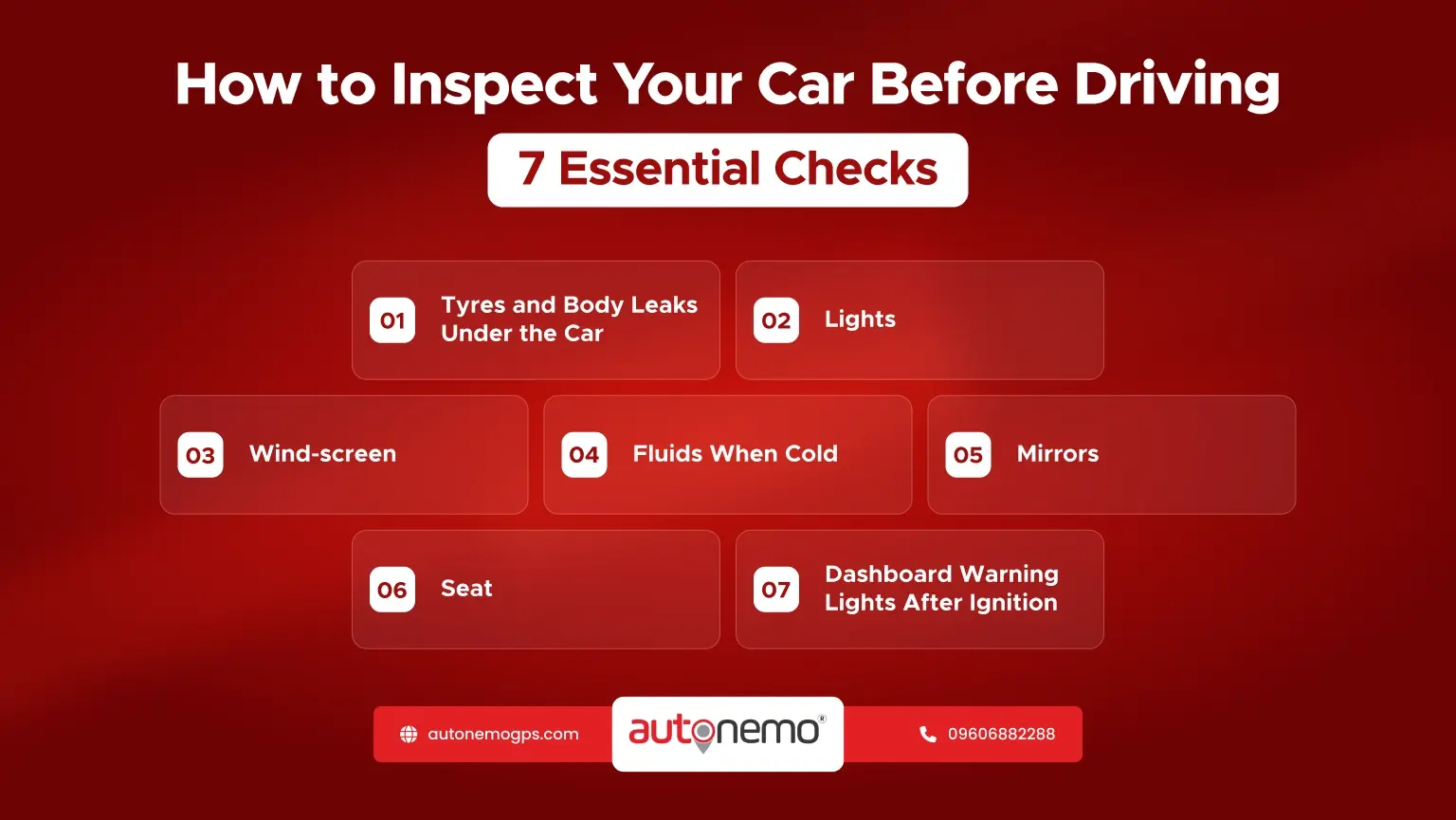
The 7 Steps Before You Start Your Car
A 30-second walk-around before you drive catches most problems while they are still cheap. Do these seven steps in order:- Walk around the car. Look at all four tires for low pressure, bulges, or nails, and check the body for new damage.
- Look under the car. Fresh wet patches on the ground mean a leak; compare the colour with the table below.
- Check the lights. Glance at headlights, brake lights, and indicators in a shop window or reflection, or ask someone to help.
- Clear the glass and mirrors. A dirty or cracked windscreen cuts visibility in rain.
- Get in and set up. Adjust the seat, mirrors, and seatbelt before moving, not while driving.
- Start the engine and read the dashboard. Warning lights should light up briefly and go out. A light that stays on needs attention.
- Let the oil circulate, then drive gently. Wait about 30 seconds after a cold start, then drive off smoothly for the first few minutes rather than idling for a long time. Modern engines warm up faster while driving.
How to read a leak by color
Place a flattened cardboard box under the engine overnight to see where and what is dripping. Colour is a clue, not proof, because it varies by brand and age.
Fluid
Typical color and feel
Where it drips
Action
Engine oil
Amber when new, dark brown or black when old, slippery
Front or middle of the engine
Check the oil level and book a workshop visit
Coolant
Green, pink, orange or blue, sweet smell, thin
Front, behind the bumper
Do not open the cap when hot; top up and inspect
Brake fluid
Clear to light amber, oily
Near a wheel or under the driver's side
Do not drive; have it inspected
Transmission fluid
Red or pink when new, dark red or brown when old
Middle of the car
Inspect soon
Power-steering fluid
Red, pink or amber
Front, near the steering rack
Inspect soon
Washer fluid
Blue or green, thin, watery
Near the windscreen reservoir
Low priority
Water
Clear, no smell
Under the car after using the AC
Normal condensation
Wipe a drop with a white paper towel before you visit the workshop so the mechanic can see the colour and smell it.
Important: If you suspect a brake fluid leak, stop driving and arrange a professional inspection. Never open a hot radiator or coolant reservoir.
How to Maintain a Car Daily, Weekly, Monthly, and Yearly
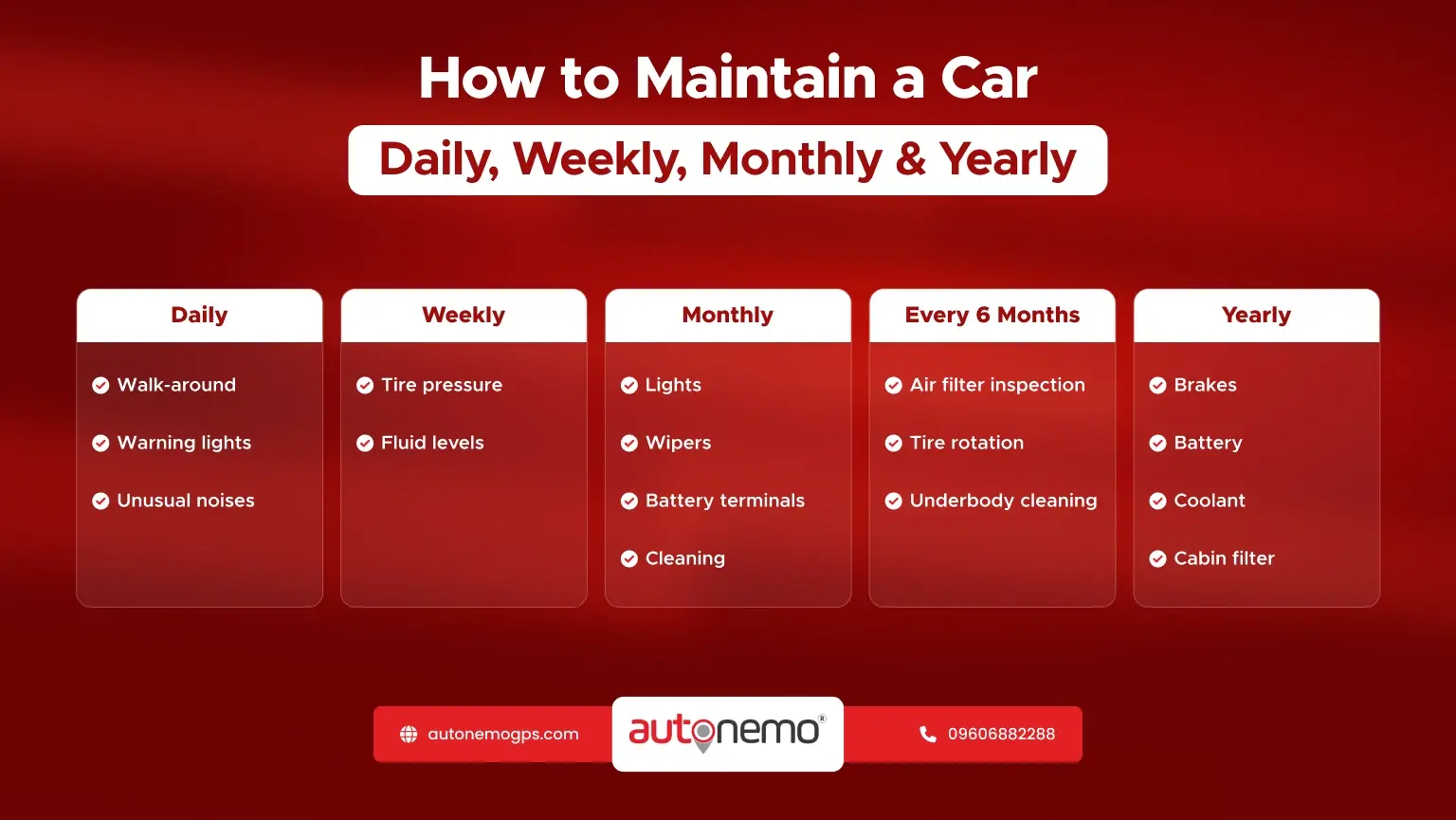
The routine below takes about 30 seconds a day and 15 minutes a month. Do the fluid and tire checks with the engine cold and the car on level ground.
Frequency
What to check
Time
Every day
Walk-around, tyres, leaks underneath, dashboard lights, new noises
30 seconds
Every 2 weeks (and before long trips)
Tyre pressure with a gauge, engine oil level, coolant level, washer fluid
10 minutes
Every month
All lights, wipers, battery terminals, brake fluid level, spare tyre pressure, wash
15 minutes
Every 6 months
Air filter, tyre rotation, tyre tread and sidewalls, wiper blades, underbody rinse
Workshop or 1 hour
Every year
Brake inspection, battery test, coolant condition, cabin filter, suspension and steering check, exhaust, emission or fitness papers
Workshop visit
Which Daily Checks Need to Be Done to Take Care of Your Car?
Daily inspections do not need to take much time.Before driving:
- Walk around the vehicle and inspect the tires.
- Look underneath for unusual fluid leaks.
- Check the dashboard for warning lights.
- Listen for unusual engine sounds.
- Make sure the mirrors, lights, and windscreen are in good condition.
How to Maintain a Car Weekly
Once a week, inspect important vehicle fluids and tyre conditions.- Tyre pressure: Check tyre pressure when the tyres are cold. Follow the recommended pressure displayed on the vehicle's tyre information label.
- Engine oil: Check the oil level using the dipstick or electronic monitoring system, following the owner's manual.
- Coolant: Check the coolant reservoir when the engine is completely cold. Never remove the radiator cap while the engine is hot.
- Brake fluid: Check the reservoir level. A low level may indicate a leak or worn brake components and should be inspected.
- Washer fluid: Ensure the windscreen washer reservoir contains enough cleaning fluid.
What to Check to Maintain a Car Monthly
Monthly inspections help maintain visibility, electrical reliability, and general vehicle cleanliness.- Test headlights, indicators, brake lights, and reverse lights.
- Inspect windscreen wipers for damage or poor performance.
- Check battery terminals for corrosion.
- Clean the interior and exterior.
- Inspect door seals and visible rubber components.
- Check the air-conditioning performance.
What to Check on a Car Every 6 Months?
Depending on your vehicle and driving conditions, a six-month inspection may include:- Inspecting the engine air filter.
- Rotating tires when recommended.
- Cleaning dirt and mud from the underbody.
- Inspecting suspension components.
- Checking belts, hoses, and visible wiring.
Which Things Must Be Checked Yearly on a Car?
An annual inspection should cover important safety and performance components.- Brake pads, discs, and brake lines
- Battery condition and charging performance
- Coolant condition and cooling system
- Cabin air filter
- Suspension and steering components
- Exhaust system
- Emissions inspection, where required
How Often Should You Service Your Car?
A good service interval is the one in your manual, in kilometres and months, whichever comes first. The figures below are typical ranges for passenger cars so you can plan; use them only where the manual is silent, and shorten them for Dhaka-type driving.
Item
Typical interval
Shorten if
Engine oil and filter, mineral oil
About 5,000 km or 6 months
Heavy traffic, short trips, dust
Engine oil and filter, fully synthetic
Up to 10,000 km or 12 months
Same as above
Tyre pressure check
Every 2 weeks, never less than monthly
Hot weather, long trips
Tyre rotation
Every 8,000 to 10,000 km
Uneven wear
Tyre replacement
Tread at 3 mm for wet roads; never below 1.6 mm; inspect from 5 years of age, replace by 10 years
Cuts, bulges, cracks
Engine air filter
Inspect every 6 months; replace about every 15,000 to 30,000 km
Dusty roads
Cabin filter
Every 10,000 to 15,000 km or yearly
Pollution, bad smell
Brake pads
Inspect at every service; replace when about 3 mm remain
Stop-and-go traffic
Brake fluid
Every 2 years (check the manual)
Humid climate
Coolant
Every 2 to 5 years or 40,000 to 100,000 km, by type
Overheating history
Transmission fluid
Commonly 40,000 to 100,000 km; CVTs often at the shorter end
Towing, heavy traffic
Spark plugs
Commonly 40,000 to 100,000 km, depending on plug type
Rough running
Battery
Test yearly; often lasts 3 to 5 years, less in heat
Slow cranking
Wiper blades
About every 6 months
Streaking
Timing belt
Often 90,000 to 150,000 km or 5 to 10 years, by model
Never exceed the manual
What is a good service interval for a car?
For most petrol cars a full service every 10,000 km or 12 months is a sensible default, with an oil service every 5,000 to 10,000 km depending on oil type. Always prefer the manual's figure, and service sooner if you mostly drive short trips or sit in traffic.
How Often Should I Change My Oil? How Many Kilometers Is Too Much Past an Oil Change?
Change engine oil about every 5,000 km with mineral oil and up to 10,000 km with fully synthetic oil, or every 6 to 12 months, whichever comes first. Going 500 to 1,000 km past the interval once is unlikely to harm a healthy engine, but treat the interval as a limit, not a target. If you are more than about 10 percent over, or the oil is dark, thick or low, change it now. Old oil loses its ability to protect the engine, and sludge builds up faster in stop-and-go traffic and heat.
The old "change every 5,000 km" rule is not wrong for mineral oil or severe driving; it just does not apply to every car. See our engine oil change interval guide for oil grades and viscosity.
What is 30-60-90 maintenance?
"30-60-90" is a US service pattern: a service at 30,000, 60,000 and 90,000 miles. In kilometres, that is about 48,000, 97,000 and 145,000 km. Because most cars in Bangladesh are serviced by kilometres every 5,000 to 10,000 km, treat it as a reminder that larger services come at roughly 50,000, 100,000 and 150,000 km:
Milestone
Typical extra work on top of the regular service
About 50,000 km (30,000 miles)
New air and cabin filters, brake fluid check, coolant check, tyre rotation and alignment check
About 100,000 km (60,000 miles)
Spark plugs, transmission fluid, coolant, belts and hoses, brake pads and discs as needed, suspension check
About 150,000 km (90,000 miles)
Repeat the 50,000 km work plus inspect shocks, mounts and bushings, water pump and exhaust
What is 100k maintenance?
100k maintenance is the major service around 100,000 miles (about 160,000 km) or at 100,000 km on many cars, when age-related parts wear out. Typical items are the timing belt and water pump (if your car has a belt; a chain usually needs inspection instead), spark plugs, coolant, transmission fluid, drive belts and hoses, shock absorbers and suspension bushings, and a full brake review. Budget for it in advance; it is the most expensive routine service but prevents the most expensive failures.
See our car service intervals by mileage guide for a full checklist for each milestone.
Severe Driving Conditions in Dhaka
Driving in Dhaka can place additional stress on a vehicle. Common severe driving conditions include:
Stop-and-go traffic: Frequent acceleration and braking can increase brake wear and engine operating stress.
High temperatures: Hot weather places additional demands on the cooling system and battery.
Dust and pollution: Dust can affect air filters, cabin filters, and engine performance.
Long idling periods: Extended idling consumes fuel and may increase engine operating hours without increasing distance travelled.
If you regularly drive under these conditions, consult your owner's manual for severe-service maintenance intervals. Your vehicle may require more frequent inspections and servicing.
What Car Fluids, Filters, and Parts Need Regular Maintenance?
Intervals are in the table above; this section tells you what to look for in each part so you notice trouble before the interval is up.
Tyres
Tyres are your only contact with the road, about the size of a palm per tyre. Check pressure, tread depth, sidewalls and wear pattern.- Tread: Most new tyres have about 8 mm. Replace at 3 mm for wet-road grip and never run below the legal minimum, which is 1.6 mm in many countries (confirm the local rule). Most tyres have wear bars in the grooves that show when you reach the limit.
- Uneven wear: Wear on one edge means alignment trouble, often from potholes. Wear in the centre means over-inflation; wear on both edges means under-inflation.
- Age: Cracks in the sidewall mean the rubber has hardened. Have tyres over 5 years old inspected every year and replace at 10 years.
- Spare: Check the spare's pressure monthly and make sure the jack and wheel wrench are in the boot.
Engine oil and filter
Oil lubricates, cools, and cleans the engine. Use the viscosity (for example, 5W-30) and specification in your manual, and change the filter with the oil. Warning signs: low level, oil pressure light, ticking noise, or blue smoke or oil that smells of fuel.
Coolant
Coolant carries heat away and protects the radiator from corrosion. Use the type the manufacturer names and a 50:50 mix with distilled water unless the bottle says otherwise. A temperature gauge rising in traffic means stop and let the engine cool.
Brake fluid and brake pads
Brake fluid absorbs moisture from humid air, which lowers its boiling point and rusts the system from inside, which is why it needs replacement about every 2 years even if it looks clean. Pads wear faster in stop-and-go driving. Squealing, a grinding noise, a soft pedal or a car that pulls to one side when braking all need immediate inspection.
Transmission fluid
Transmission fluid cools and lubricates the gearbox. Hesitation, jerky shifts or a burnt smell mean it is overdue or the transmission is slipping. Use only the fluid type in the manual, since the wrong one can damage automatic and CVT gearboxes.
Air filter and cabin filter
The air filter stops dust entering the engine; a clogged one raises fuel use and reduces power. The cabin filter cleans the air coming through the vents; replace it when the AC smells musty or airflow weakens. Both wear out faster in Dhaka's dust.
Battery
A battery usually lasts 3 to 5 years, and heat shortens that. Slow cranking, dim headlights and a dashboard battery light are early signs. Keep the terminals clean and tight, and have the battery and the alternator tested before it fails rather than after.
Wipers and lights
Replace wipers about every 6 months or when they streak, and replace blown bulbs immediately. A bare wiper arm can scratch the windscreen, and a dead brake light is both a safety and a legal problem.
Car Care in Bangladesh's Climate and Roads
Bangladesh's weather and road conditions create several maintenance challenges. Understanding these conditions can help prevent unnecessary vehicle damage.
Monsoon and Flooding
Heavy rainfall and waterlogged roads can create serious risks for vehicles.Driving through standing water may allow water to enter the engine through the air intake. This can cause hydrolock, a condition that can lead to severe engine damage.
Other possible problems include:
- Electrical system damage
- Contaminated engine oil
- Brake performance problems
- Corrosion
- Damage to underbody components
If your vehicle has been submerged or water has entered the engine area, do not attempt to restart it. Arrange a professional inspection.
Heat and Humidity
High temperatures and humidity can affect multiple vehicle components. Pay attention to:- Coolant levels and radiator condition
- Battery condition and terminal corrosion
- Air-conditioning filters
- Tyre pressure
- Rubber hoses and belts
Dhaka Stop-and-Go Traffic and Potholes
Frequent braking and uneven roads can increase wear on several components. Inspect:- Brake pads and discs
- Shock absorbers and suspension
- Steering components
- Wheel alignment
- Tyres and rims
Fuel Quality and Filling Habits
Fuel quality is important for engine performance and reliability. Use reputable fuel stations and the correct fuel type for your vehicle. Check the pump display and nozzle before refueling to ensure the correct fuel is selected.
Never use petrol in a diesel vehicle or diesel in a petrol vehicle. If the wrong fuel is added, do not start the engine. Seek professional assistance.
How to Prevent Rust on a Car
Rust develops when metal is exposed to moisture and oxygen, especially when protective coatings are damaged. To reduce the risk:- Wash the vehicle regularly, particularly after driving through muddy or contaminated water.
- Rinse the underbody when necessary.
- Repair paint chips and scratches.
- Keep the vehicle dry whenever possible.
- Apply suitable automotive wax or paint protection.
- Inspect wheel arches, door edges, and underbody areas for corrosion.
Is It Okay to Leave a Car for 2 Weeks?
Yes, leaving a properly maintained car unused for two weeks is generally fine. However, some precautions can help prevent battery problems, tyre issues, and other storage-related concerns. Consider these factors:
Battery: An older or weak battery may lose enough charge to prevent the car from starting.
Tyres: Long periods of stationary parking can sometimes cause temporary flat spotting or pressure loss.
Fuel: Petrol and diesel can generally remain in a properly maintained fuel system for two weeks without special treatment.
Pests: Insects and rodents may enter vehicles parked in unsuitable locations.
How to Prepare a Car for 2 Weeks, 1 Month, or 3 Months
Storage period
Recommended preparation
2 weeks
Park safely, check tyre pressure, close windows, and ensure the battery is healthy.
1 month
Consider a battery maintainer if appropriate, check fluid levels, and protect the vehicle from moisture.
3 months
Follow the manufacturer's long-term storage instructions, consider professional storage preparation, and inspect the vehicle before restarting.
Battery: Modern cars draw a small current even when switched off (alarm, clock, computer memory), so an older battery can go flat in two to four weeks, faster in heat.
Tyres: Standing on one spot can leave temporary flat spots; they usually disappear after a few kilometres of driving. Tyres also lose a little pressure each month.
Fuel: Petrol and diesel stay usable for a couple of weeks. After several months, fuel can degrade; ask a workshop what to do.
Pests and moisture: Rats and insects chew wires and nest in air filters; damp interiors grow mould. Remove food, and clear leaves and dirt.
How to Restart Safely After Storage
Before driving a car that has been parked for an extended period:- Inspect the tyres and check their pressure.
- Look underneath for fluid leaks.
- Check engine oil and coolant levels.
- Inspect the battery.
- Look for signs of pest damage.
- Check the brakes and dashboard warnings.
How to Care for a New Car
Taking care of a new car from the beginning can help maintain its condition and performance.- Follow the break-in instructions in the manual. Some makers ask for gentle driving and a variable speed for the first few hundred kilometers; modern cars often need little, but follow your manual, not a rule from another car.
- Do the first service on time. It checks for early defects and is often required to keep the warranty valid.
- Protect the paint early. Wash with a proper car shampoo and soft microfibre cloths, not household detergent or dry wiping, and apply a sealant or wax every few months.
- Read the manual and learn the dashboard lights. Know where the fuse box, the jack, and the spare are.
- Keep every invoice. Records protect warranty claims and resale value.
- Avoid accessory shortcuts. Cheap electrical add-ons can drain the battery or void warranty coverage; ask the dealer before fitting them.
Car Care Myths That Cost You Money
Some popular advice wastes money or damages the car. Use this table to check what you have heard.
Myth
Verdict
The facts
Inflate tires only when they look soft.
False
You cannot judge pressure by eye; a tire can be 20 percent low and look normal. Use a gauge every 2 weeks.
Change oil every 5,000 km, always.
Partly true
Right for mineral oil and severe driving; synthetic oil can often go up to 10,000 km. Follow the manual.
Engines need several minutes of warm-up.
False
Idle about 30 seconds, then drive gently. Modern engines warm up faster under light load.
Filling up in the morning gets you more fuel.
False
Petrol does not change volume enough underground to matter.
Screeching always means engine trouble.
Partly true
Often it is worn brake pads or a loose belt, so have it checked either way.
Premium fuel always improves performance.
False
Use the grade your manual specifies; a higher grade gives no benefit in an engine not designed for it.
Washing the car often damages the paint.
Mostly false
Dirt and bird droppings damage paint more. Poor technique (dry wiping, dirty sponges, harsh brushes) is what scratches it.
A car that is rarely driven needs no maintenance.
False
Oil, brake fluid, rubber, and the battery age with time as well as distance.
A warning light still off means the car is fine
False
Many problems develop before a light comes on, so keep doing your checks.
The Silent Killers of a Car
The "silent killers" are faults that give little warning but cause expensive or dangerous failures. Check each one at every service.
- Exhaust leaks and carbon monoxide. A leak under the car can let colorless, odorless carbon monoxide into the cabin. Signs are a louder exhaust, headaches, or drowsiness while driving. Never idle in a closed garage, and have any leak fixed at once.
- Old brake fluid. It absorbs humidity, loses braking performance when hot, and corrodes the system from inside. Replace about every 2 years.
- A weak battery. It fails without warning, usually on the hottest or wettest day. Test yearly after year 2.
- Low or old coolant. Overheating can warp the cylinder head or blow the head gasket, which can cost more than an older car is worth.
- Worn or old tires. Low tread, cracks, and age reduce grip on wet roads and cause blowouts.
- Neglected oil. Sludge forms slowly and then kills engine bearings.
- Rust in hidden places. Brake lines, sills, and the underbody can corrode out of sight.
The cure is the routine in this guide: regular checks, on-time service, and acting on small changes.
DIY vs Professional: What You Can Do and What to Leave to a Mechanic
You can do the checks; a trained technician should do the repairs that affect safety or need special tools.
DIY maintenance
Professional maintenance
Tyre pressure and visual tyre check
Wheel alignment and balancing
Engine oil, coolant, and washer fluid levels
Oil change if you cannot dispose of oil safely
Replace wipers and bulbs.
Brake pad, disc, and fluid replacement
Clean battery terminals
Battery and alternator testing, electrical faults
Wash, wax, and vacuum.
Timing belt, transmission, and engine work
Check lights and for visible leaks.
Suspension, steering, and AC repair
Never work under a car held only by a jack. Use rated axle stands on level ground, chock the wheels that stay on the ground, and leave the job if unsure.
How to Find a Trustworthy Mechanic
When selecting a workshop, consider:- Ask friends, family, and local owners of the same make, and read recent reviews.
- Look for a clean workshop, trained technicians, and branded diagnostic equipment.
- Ask for a written estimate before work starts and an itemized invoice afterwards.
- Ask to see replaced parts and for the reason each part was replaced.
- Use genuine or reputable-brand parts and oils, and ask for the part brand.
- Start with a small job, such as an oil service, to judge their honesty before a big repair.
- Stay loyal once you find a good one; regular customers get more attention and better advice.
Why Roadside Assistance Matters
Even a well-kept car breaks down. Save the number of your insurer's or dealer's roadside service, a trusted towing service, and your mechanic on your phone before you need them, and keep a printed copy in the glove box.
Safety Kit and Basic Tools to Keep in Your Car
A basic vehicle emergency kit can help you handle minor problems and stay prepared while waiting for assistance.Consider keeping these items in your car:
- Spare tire in good condition, jack, and wheel wrench
- Tire pressure gauge and a 12-volt tire inflator
- Jump leads or a jump starter
- Torch with spare batteries
- Spare fuses and a basic tool kit (screwdrivers, pliers, and a spanner set)
- Reflective warning triangle and a high-visibility vest
- First-aid kit and a small fire extinguisher
- Drinking water and a phone charger or power bank
- Registration, insurance copies, and emergency numbers
The boot is not storage. Remove unnecessary weight, because extra load raises fuel use.
Important safety reminder: Never work underneath a vehicle supported only by a jack. A properly rated jack stand and suitable safe working conditions are essential. If you are unsure, leave the task to a professional.
How a Vehicle GPS Tracker Helps You Take Better Care of Your Car

A GPS tracker does not fix a car, but it gives you the data that maintenance depends on: how far the car really travelled, how it was used, where it was parked, and how much fuel it burned. That turns "I think it is due" into "It has done 4,800 km since the last service."
Autonemo's tracking platform, available at autonemogps.com, supports real-time tracking, trip history and route replay, fuel consumption reports, monthly driving and stoppage reports, geofence alerts, and OBD plug-and-play devices for compatible cars.
1. Mileage and trip history: service by real distance
Oil, filters, tyres and brakes are scheduled by distance. Trip history shows the distance the car travelled in any period, so you can compare it with your last service date and book the next one on time. It also shows how much of the car's use is short city hops, which count as severe service.
2. Fuel consumption reports: spot problems early
A sudden rise in fuel use for the same trips can point to underinflated tires, a clogged air filter, dragging brakes, or an engine fault. A report cannot diagnose the cause, but it tells you something changed and when, so you can run through the two-week checklist and then visit a mechanic.
3. Stoppage and idling reports: reduce wear
Long idling burns fuel and adds engine hours without adding distance. Stoppage reports show where and for how long the car stands with the engine on, helping you cut idling and see whether your car lives in severe-service conditions.
4. Parking alerts and geofencing: protect the car between services
Set a geofence around home, the office, or a parking area and receive an alert when the car enters or leaves. If the car moves when it should be parked, you know immediately. That matters because theft and unauthorized use damage a car's condition and value. Read our vehicle theft prevention guide for more.
5. Driving behavior: brakes, tires, and suspension last longer when driven smoothly
Harsh braking, fast acceleration, and hard cornering wear brakes, tires, and suspension faster. If your tracker or fleet platform reports these events, use them to coach drivers, especially for hired drivers and shared company cars. See our driver behavior monitoring guide.
6. OBD plug-and-play trackers
An OBD tracker plugs into your car's diagnostic port, usually under the dashboard, and needs no wiring. It suits owners who want an easy install on a hybrid or a new car where they do not want to cut into the wiring. Check compatibility with your model before you buy. Read our OBD GPS tracker guide to see how it works.
Bottom line: Maintenance stays your responsibility, and a tracker does not replace servicing. But the car's real distance, use, and parking history make your service schedule more accurate. To see which tracker suits your car, view Autonemo's car GPS tracker options.
Car Maintenance Checklist: A Simple Guide for Every Driver
Use this checklist to build a consistent maintenance routine.
Task
Frequency
Completed
Inspect tires.
Daily
☐
Check dashboard warnings.
Daily
☐
Listen for unusual noises.
Daily
☐
Check tire pressure.
Weekly
☐
Check engine oil
Weekly
☐
Inspect coolant level
Weekly
☐
Check washer fluid.
Weekly
☐
Test vehicle lights
Monthly
☐
Inspect windscreen wipers
Monthly
☐
Check battery terminals.
Monthly
☐
Inspect air filter.
As scheduled
☐
Rotate tires.
As scheduled
☐
Inspect brakes.
As scheduled
☐
Change engine oil and filter.
As scheduled
☐
Review service records.
Regularly
☐
Consistency beats intensity: a 10-minute check every two weeks does more for your car than one big service a year.
FAQs About Maintaining a Car Daily
How Can I Improve My Car's Fuel Efficiency?
Maintain the correct tire pressure, avoid unnecessary idling, accelerate smoothly, remove unnecessary weight, and follow the manufacturer's servicing schedule. Regularly checking the air filter and engine condition can also help.
How Often Should I Wash and Wax My Car?
Wash your car whenever dirt, mud, or contaminants accumulate. In Bangladesh, washing every one or two weeks may be a practical routine for many drivers, depending on usage and weather. Apply automotive wax according to the product instructions and your paint protection needs.
How Can I Protect My Car's Paint from Sun Damage?
Park in shaded or covered areas whenever possible. Regular washing, suitable automotive wax, and quality paint protection products can help reduce the effects of sunlight and environmental contaminants.
What Causes a Car's Air Conditioner to Stop Cooling Properly?
Common causes include refrigerant leaks, a dirty cabin filter, condenser problems, compressor faults, or electrical issues. A qualified technician should inspect the system rather than simply adding refrigerant without identifying the cause.
How Do I Know if My Car's Suspension Needs Repair?
Warning signs include unusual knocking noises, excessive bouncing, uneven tyre wear, poor handling, or the vehicle pulling to one side. Arrange a professional inspection if you notice these symptoms.
What Causes a Car to Overheat While Driving?
Possible causes include low coolant, radiator problems, a malfunctioning thermostat, cooling fan failure, water pump problems, or coolant leaks. Stop safely if the temperature warning appears and allow the vehicle to cool. Never open a hot cooling system.
How Can I Tell if My Car's Alternator Is Failing?
Possible signs include a battery warning light, dimming headlights, electrical problems, or repeated battery discharge. A technician can test the charging system to confirm the problem.
Why Does My Car Vibrate When Driving or Braking?
Vibration can result from unbalanced tires, damaged suspension components, wheel alignment issues, worn engine mounts, or brake disc problems. The cause depends on when the vibration occurs.
How Can I Remove Bad Smells from My Car's Interior?
Remove rubbish, clean carpets and upholstery, inspect the cabin filter, and identify the source of the smell. Persistent musty or unusual odors may indicate moisture, mold, or another underlying problem.
How Can I Maintain a Car That Is Driven Only Occasionally?
Check the battery, tire pressure, fluid levels, and storage conditions regularly. Follow the manufacturer's long-term storage instructions and arrange periodic inspections. Do not rely on occasional short trips as a substitute for proper maintenance.


